
A Simple Framework to Evaluate Church Staff Performance and Culture

Most leadership teams don’t actually agree on who’s performing and who isn’t on a church staff. That might sound obvious at first, but it becomes a real problem when you sit in a room and realize just how far apart people are.
One leader thinks someone is doing great, another thinks they’re underperforming, and someone else isn’t sure what to think but doesn’t want to say the wrong thing.
So what happens?
Conversations go in circles
Frustration starts to build under the surface
And the person in question gets no real clarity on where they stand
Not because your team is dysfunctional, but because you don’t have a shared way to evaluate people.
The Real Problem Isn’t the Person
Most teams assume they have a “people problem.”
But more often than not, it’s actually an alignment problem.
When there’s no clear framework:
Everyone defaults to their own definition of “good”
Performance gets confused with personality
Culture becomes a vague, unspoken expectation
And over time, that lack of clarity compounds.
You start to:
Keep people in roles that aren’t a fit
Avoid hard conversations because you can’t articulate the issue
Lose trust on your leadership team because decisions feel inconsistent
The result? You’re leading based on gut feel instead of shared clarity.
A Simple Framework That Changes the Conversation
When we work with teams, we introduce a simple but powerful exercise. Every team member gets evaluated on two things:
1. Performance
Are they delivering in the role they’ve been given?
Are they meeting or exceeding expectations?
Are they moving the ministry or organization forward?
Are results improving, staying flat, or declining?
2. Culture
Do they live out how your team behaves and works together?
Do they align with your values?
Are they someone you want new team members to learn from?
Do they contribute to the health of the team or quietly erode it?
That’s it.
Not ten categories, not a complicated scorecard, just performance and culture.
What Becomes Clear (Very Quickly)
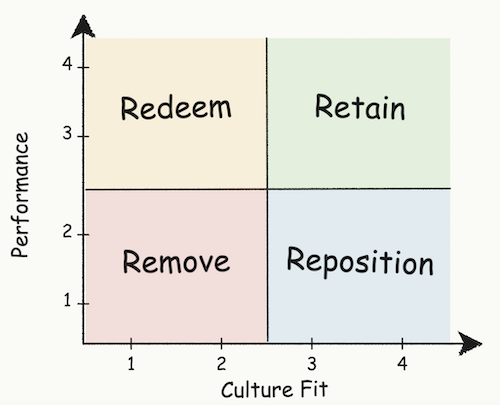
When you map those two things together, clarity shows up fast. You can immediately see four types of team members:
High Performance + High Culture
These are your strongest people.
They deliver results
They embody your culture
They’re the people you wish you could clone
Your job:
Retain, recognize, and reward them. These are your key players.
High Culture + Low Performance
These are often your most loved people.
They’re deeply aligned with your team
They carry your culture well
But they’re struggling in their role
Your job:
Reposition or retrain them. Sometimes they’re in the wrong seat, and sometimes they just need support. But ignoring it isn’t kind to them or to the team.
Low Culture + High Performance
This is the tricky one.
They’re getting results
But they’re not aligned with how your team works
They can be difficult, divisive, or inconsistent
These are often the people who get a pass because “they’re producing.”
Your job:
Address it quickly.
Set clear expectations
Coach toward behavior change
Put a timeline around it
If you don’t, you’ll lose your best people.
Low Culture + Low Performance
This one is usually clear, but often avoided.
They’re not delivering results
They’re not aligned with your culture
And they’re draining time, energy, and resources
Your job:
Have the hard conversation. Delaying this doesn’t protect anyone; it just prolongs the impact on your team.
Here’s a simple graphic to help keep the quadrants straight.
Why This Matters More Than You Think
This isn’t just about evaluation. It’s about alignment and leadership clarity.
When your team doesn’t have a shared framework:
Decisions feel inconsistent
Trust erodes internally
Culture gets defined by what you tolerate
But when you do have clarity:
Conversations get faster and more honest
Your leadership team speaks the same language
People actually know where they stand and how to grow
And maybe most importantly, you stop guessing.
Where to Start
You don’t need a big rollout.
Start simple:
Take your leadership team through this exercise
Evaluate each team member individually first
Then compare and discuss together
You’ll likely uncover:
Misalignment you didn’t realize was there
People who need clarity or coaching
And a few conversations you’ve been putting off
That’s the work.
Want to Walk Through This With Your Team?
In this episode of The LeadingSmart Podcast, we walk through this exercise step-by-step: How to run it, what to look for, and how to lead the conversations that come out of it.
If your team has felt even slightly misaligned, it will help.
Listen here:
And if you want help facilitating this with your team, we’d love to walk through it with you. Book a time with our team.